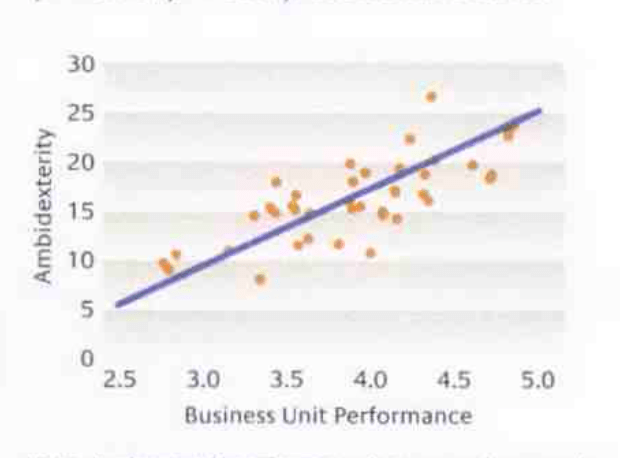
An agile leader in a business is inquisitive, collaborative, willing to change and pivot when it is required (Coleman, 2017)1. A successful company constantly evolves to meet market trends. Gibson and Birkinshaw (2004)2 found that it is statistically significant that the performance of a business unit is positively correlated to ambidexterity (r=0.76), which is a result of the combination of adaptability and alignment.
A scatter plot of ambidexterity and performance
With that said, leaders need to be adaptive in a changing market. Meanwhile, they must be consistent in pursuing the goal of a company. I was grateful that I could develop adaptive skills in a business consulting project at the University of Sydney. In the digital industry project, our team developed secondary markets for a coaching business.
When we were evaluating the feasibility of the company to enter the proposed markets, I identified changes in the market and used TOWS analysis to calibrate the targeting strategy. My marketing research suggested that the mix of migrant and non-migrant workers in different industries has changed, customers become more diverse and businesses rebounded after Covid-19.
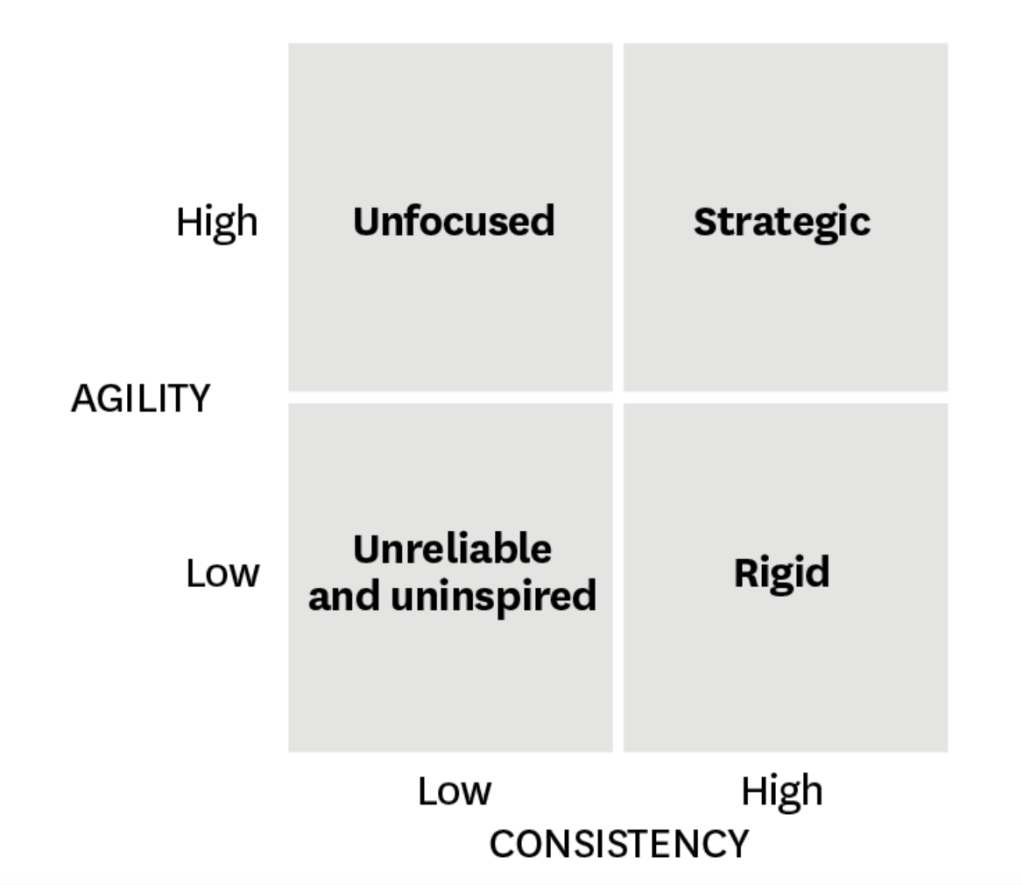
In light of these changes, I refined the proposed target segments, which would also fit the company strategically. Coleman (2017) demonstrated that a strategic leader is both agile and consistent so as to achieve excellent performance with a company’s purpose and change course when the market demands it.
2×2 matrices of the qualities of leaders
This is useful when I am making recommendations for a business based on data. I can notice changes in customer preference through data analysis, which will help the company navigate different market situations.
- Coleman, J. (2017). To Be Strategic, Balance Agility And Consistency. HBR Guide to Thinking Strategically (pp.27 -32). Harvard Business Review Press. ↩︎
- Birkinshaw, J., & Gibson, C. (2004). Building Ambidexterity Into an Organization. MIT Sloan Management Review, 45(4), 47-55. http://ezproxy.library.usyd.edu.au/login?url=https://www-proquest-com.ezproxy.library.sydney.edu.au/scholarly-journals/building-ambidexterity-into-organization/docview/224963339/se-2 ↩︎

