Hunter (2014)1 defined critical thinking as reasonable, reflective thinking to decide what to believe and do. Being able to challenge assumptions is a type of critical thinking. Nosich (2009)2 proposed that a critical thinking process involves evaluating and comparing 8 elements of thoughts in context, of which reasoning about assumptions is one.
8 Elements of Thought
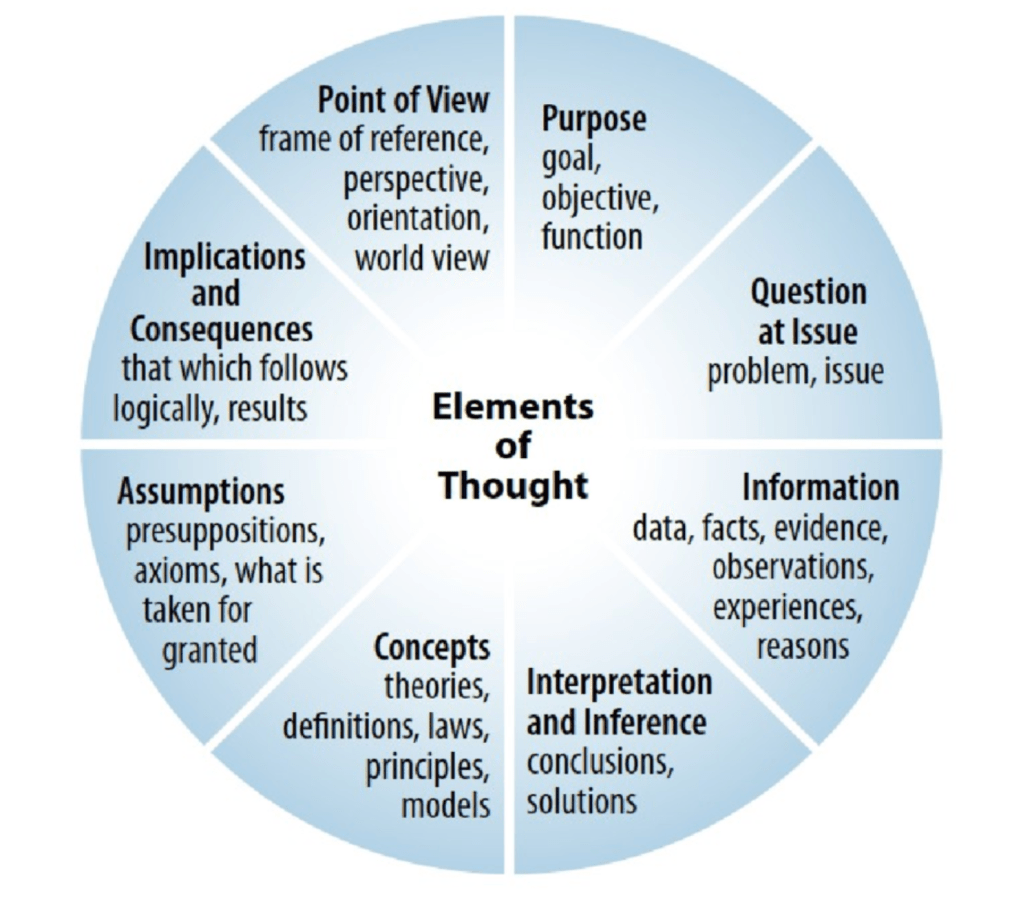
Challenging skills ensure that assumptions are grounded. When the premises of an argument are not true, the argument is not good (Hunter, 2014). In other words, knowing when and how to question assumptions is necessary to arrive at a sensible argument.
When our team was planning on assessing which segments fit the growth strategy of our client’s company, I raised questions about the market size of target customer segments. Although some of the proposed segments matched the core competency of the company, they could not stand as a profitable income source. By practising the skills, I am more aware of what is presumed to be true in my data arguments, and avoid confirmation bias in data analysis and interpretation.
- Hunter, D. A. (2014). Reasoning About Alternatives And Necessary And Sufficient Conditions. In (Ed.), A Practical Guide to Critical Thinking (2nd ed., pp. 196-261). Wiley. ↩︎
- Nosich, G. M. (2009). Learning to think things through: a guide to critical thinking across the curriculum (3rd ed.) Pearson Education. ↩︎
- Elder, L. & Paul, R. (2012). Elements of Thought [image]. In The Thinker’s Guide to Analytic Thinking: How to Take Thinking Apart and What to Look for When You Do (p. 5). Critical Thinking Foundation Press. ↩︎

